University of Oregon Knight Library Oregon Public Art Archives
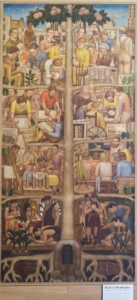
Library Mural
"Development of Science"
Photograph Credit: Howard Davis
Just equally the controversy over the Victor Arnautoff murals in San Francisco's George Washington High School draws national and fifty-fifty international attention, New Deal era murals in the University of Oregon's main library stir debate over public art, representations of gender and race, and conditions for an inclusive campus environment. The future of the Knight Library murals, yet, was decided in a much different manner, with a much different determination–and offers a model for engagement with challenging public art.
The controversy surrounding the Knight Library murals began several years ago as students launched successive protests over iii murals installed as part of the 1937 New Deal-era library's east and westward stairwells. The focus was on the WPA artists Arthur and Albert Runquist'southward pictorial murals "The Development of Scientific discipline" and "The Development of Art." The Runquist brothers, graduates of the University of Oregon, shipyard workers and regionally known artists, were associated with progressive politics. Today's critical analysis, still, draws attention to their selective narrative. As shown in "The Development of Science," progress is suggested past a tree portraying eight vignettes from the early human discovery of burn down and agriculture to science in the early 20thursday century. Its emphasis on Western civilization and a limited representation based on gender and race normalizes forms of privilege that university values presumably should challenge. Certainly, xx-outset century UO students have.
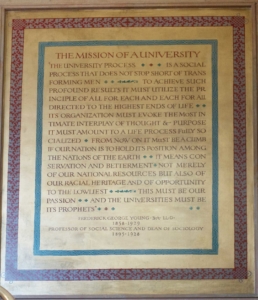
Landscape, "The Mission of a Academy"
The words "our racial heritage" were defaced with red ink.
Photo Credit: Howard Davis
The mural that draws the greatest fire, however, is titled "The Mission of a University," inscribed on the wall as if it were a medieval manuscript. The text borrows from a 1909 speech by UO Sociology professor Frederick Young in which he argues the service required of a academy, contending: "From at present on it must be a climb if our nation is to hold its position amongst the nations of the Earth. It means conservation and betterment not just of our national resources but also of our racial heritage and of opportunity to the lowliest."
A student petition, filed in November 2017, chosen for the Academy to remove it—mobilizing over ane,750 students in the process. During the summer of 2018, the landscape was defaced. A protestor highlighted the phrase "racial heritage" with red paint and left a taunting note: "Which fine art exercise y'all choose to conserve now?"
The library administration's response was to clean the mural, ship the note to be archived equally part of the campus' history of protest, and to place a placard next to the mural acknowledging the defacement, yet calling for "continuing our cross-campus project to contextualize these artifacts for educational and cultural reasons, and for allowing them to remain uncensored every bit prove of the embedded racist and sexist legacy against which many of usa all the same struggle."
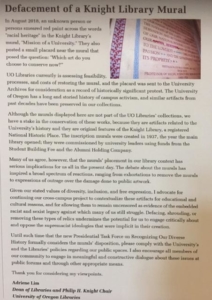
Librarian's Response
Placard addressing vandalism of the Knight Library Mural
Photo Credit: Judith Kenny
Education rather than erasure has been the consistent response from the administration. This might, in function, exist understood as an aspect of its conservation responsibilities for a building with historic preservation requirements. Completed in 1937, the Knight Library was placed on the National Register of Celebrated Places in 1990. It exemplifies the quality of public building that could be produced through the financing of the New Deal's PWA and WPA programs and the creativity inspired by the WPA Federal Arts Programme. Because the murals are embedded in the library's walls, removal would likely destroy them. But the conservation of a building, as the placard cited, is less an result than is the uncensored show of an "embedded racist and sexist legacy."
Fifty-fifty as protests took place, in February 2017, Adrienne Lim, Dean of Libraries, launched the Knight Library Public Art Task Forcefulness, charged with several tasks. Simply concluding calendar month, it submitted its report to the University Senate.
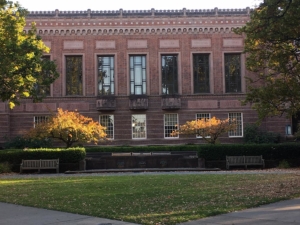
Knight Library
Academy of Oregon, Eugene, Oregon
Photograph Credit: Howard Davis
The first chore was to set a committee of library faculty members to piece of work on a guide to the library's historic resources. The 2nd, overseen by a commission of students and faculty members, involved conducting a public forum, "Public Fine art, Cultural Memory, and Anti-Racism" to explore public art as an antiquity representing past and contemporary values. The third job undertook a juried showroom of student art that reflected contemporary values, titled "Show Upwardly, Stand Out, Empower!"
A public forum, "Public Art, Cultural Retention and Anti-racism," discussed the implications of removing the "The Mission of the University" mural. Professor Laura Pulido, Caput of the Department of Indigenous Studies, argued confronting removal, "I understand that many want to tear downwards racist symbols of the past for reasons I respect. But I am opposed to such erasures," she said, adding, "The simply style to move forward to not be held hostage to our past is to engage the past."
Source: https://livingnewdeal.org/tag/knight-library/
0 Response to "University of Oregon Knight Library Oregon Public Art Archives"
Post a Comment